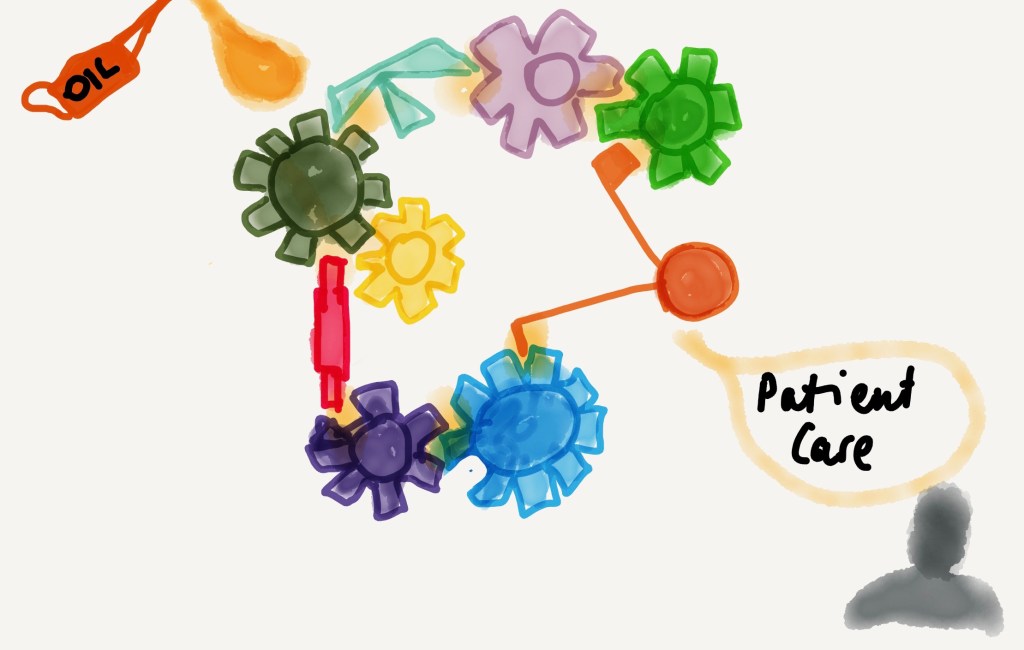
There are many different parts in delivering palliative care to patients – the patient themselves, their family or care supports and their community. Health and social care professionals add in to the picture and it becomes an intricate piece of machinery. Conditions for which that palliative care approach have expanded beyond cancer over the past 30 years and for each of these conditions there are new developments, new interventions, new side effects and different balancing measures with quality of life. The problem is however, that the ‘product’ – patient care is unique to that individual and their own particular circumstances – so the machinery needs care and careful maintenance.
What needs to be done to help this delicate machine to work and keep working – what is the ‘oil’?
It might be:
- Communication between teams or people – how does it work ? What makes it effective? are communications in person or virtual – and whatever mode of communication, has it been reviewed and agreed that it is the most practical for that particular situation or person?
- The setting – can the setting where palliative care is delivered be improved? … practically… and not all settings can in the immediate… but might there be scope for developing something that will help the team to work in the future
- Knowledge – both about the condition and the palliative care needs and thus their options for management. It might also be knowledge of who else is about to help deliver palliative care to that person – is there a ‘blind spot’ about a useful resource perhaps?
- the skill mix of the team – there’ll be more about that in later posts – this is so interesting – there are the professional skills of the team – each person’s role in the care of that patient… but there is also the team behaviour or personality mix of the team…. are there enough people of diverse personalities to enable things to happen…?
Even in the very highly pressured health care delivery world of 2024 and beyond, with staff morale/ staff sickness and recruitment pressures, it can be useful to gather together and think about how the team works… and always, always keeping the patient central to those discussions.
 Sharing Palliative Care